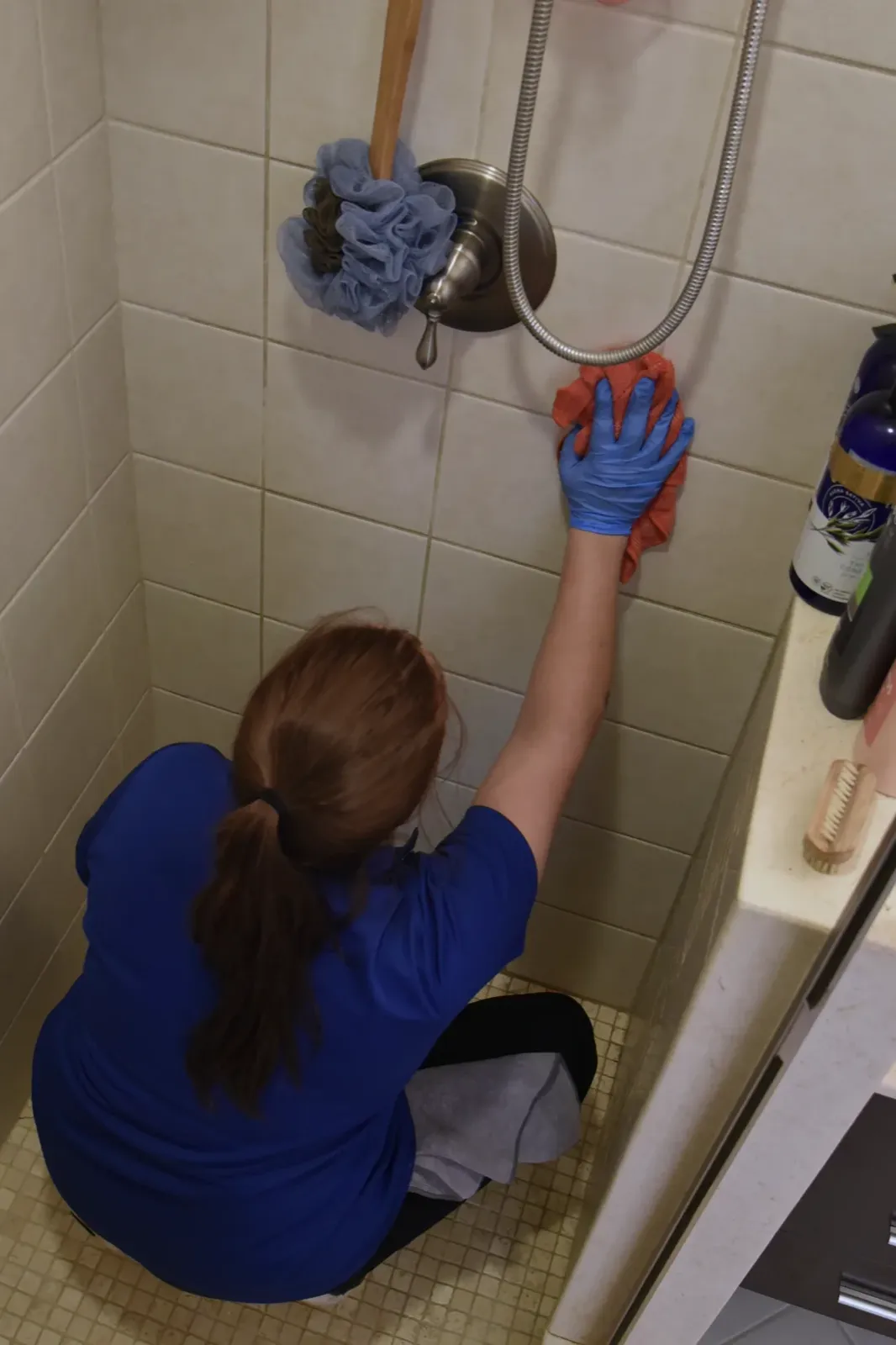
Hotels use no secret product. Housekeeping cleans and squeegees the glass every day, so film never gets more than about twenty-four hours to bond — and when a door will no longer come clear, the hotel replaces it. Frequency and a replacement budget, not chemistry, are the answer.
Happy Maids has cleaned bathrooms around Barrington since 1985, in some of the hardest tap water in Illinois. This is the honest version of the hotel question — what is actually happening in that bathroom, which parts of it you can copy at home, and the mistakes that will cost you a shower door.
What do hotels actually use on glass shower doors?
Ordinary acidic bathroom cleaner, a non-scratch pad and a squeegee. The products sit in the same chemical family as what you can buy: a mild acid that dissolves the mineral half of the film, usually blended with a detergent that lifts the soapy half.
There is no hotel-only bottle. What a hotel has that a house does not is somebody cleaning that glass every single day.
- The enclosure is wiped as part of the room turn — on a schedule, whether or not anyone thinks it looks dirty
- The glass is squeegeed dry at the end — the water leaves the surface before it can evaporate, and evaporation is the step that deposits the mineral
- Nothing on it is ever older than a day — a twenty-four-hour film wipes off with a damp cloth, where a season-old film has to be dissolved
That is the whole trick, and it is unglamorous. Frequency is doing the work everybody assumes a product is doing.
Why does hotel shower glass look clearer than yours?
Three reasons, and only the first one is about cleaning. The other two are structural, and they are the part of the comparison nobody mentions.
- It is cleaned daily, by somebody paid to do it. Your shower gets cleaned on a good week. Theirs gets cleaned every day of the year
- It is younger than yours. Hotel bathrooms are refurbished on a cycle, and an enclosure that no longer comes clear gets replaced rather than scrubbed harder. A homeowner rarely budgets for that, so a home shower door can be carrying twenty years of history that a hotel door is not
- Nobody actually lives in it. A guest showers two or three times in that room. A family of four uses their own shower well over a thousand times a year, and every one of those showers lays down another film
So the fair comparison is not your bathroom against a hotel bathroom. It is your bathroom against a hotel bathroom that is cleaned three hundred and sixty-five days a year and gets new glass when it stops responding.
Do hotels use stronger chemicals than you can buy?
Sometimes, and it is far less of an advantage than it sounds. Commercial bathroom cleaners are frequently sold as concentrates, diluted to a written ratio, and used by trained staff with gloves in a room with the fan running.
A hotel is also working on surfaces that make strong chemistry safer than it would be at home:
- A standardized enclosure — the same glass, the same frame and the same tile in three hundred rooms, so the housekeeper already knows what the product does to it
- Usually no natural stone in the shower — the marble bench, sill or threshold that acid would permanently etch in a home bathroom is often simply not there
- A maintenance department — when something does get damaged, there is a trade on site and a budget to fix it
Copying hotel chemistry is the single worst way to copy a hotel. Copy the squeegee instead. It takes fifteen seconds, it costs almost nothing, and a rubber-bladed squeegee cannot scratch glass — just avoid the ones with a bare metal edge, which can.
Why is shower glass harder to keep clear around Barrington than in most of the country?
Because there is far more calcium and magnesium in the water here to leave behind, and it is not a small difference. Water hardness is measured in grains per gallon, and above roughly 10.5 grains a supply is already classed as very hard.
These are published figures from the villages themselves:
- Barrington — around 23 grains per gallon. The Village pumps its own supply from the ground
- Cary — 24 to 27 grains. The Village's own water FAQ gives that range across its municipal wells and attributes the hardness to the high gravel content in the soil
- Fox River Grove — 28 grains. Stated plainly in the Village's water quality report, alongside its own note that anything above 10.5 grains is considered very hard. It is the hardest figure in our whole service area
- None of these villages soften the water municipally — what comes out of the ground is what arrives at your shower head
For scale against a national benchmark, the USGS classifies anything above 180 mg/L as very hard water. One grain per gallon is about 17 mg/L, so 23 grains is roughly 390 mg/L and 28 grains is roughly 480 mg/L — more than double the point at which water is already called very hard.
That is why shower glass is a constant subject in house cleaning in Barrington, house cleaning in Cary and house cleaning in Fox River Grove, and barely a topic in a Lake Michigan suburb twenty miles east. Same soap, same shower habits, several times the mineral load.
One local wrinkle worth knowing. Plenty of homes out here sit on private wells with no municipal iron treatment, and untreated iron stains orange-brown rather than chalky white. If your marks are rust-colored rather than white, you are looking at an iron problem, and a general bathroom cleaner will set it rather than lift it.
How do you get the hotel result at home?
By copying the routine rather than the products. The habits below are what actually keep glass clear, in rough order of how much difference each one makes.
- Squeegee after every shower. Fifteen seconds, top to bottom, and the water is gone before it can evaporate and leave its mineral behind. This is the single highest-value habit on the page
- Switch off bar soap. The fatty acids in bar soap are the raw material for the film — a synthetic-detergent body wash removes most of that supply, and what does rebuild is thinner and easier to remove
- Run the exhaust fan for twenty minutes afterwards and leave the shower door open, so the enclosure genuinely dries rather than sitting damp
- Dry the door track and the fixtures. The bottom track holds standing water, which is where the next round of buildup starts, and chrome spots in this water unless it is dried by hand
- Clean weekly rather than seasonally. A week-old film wipes off. A season-old film has to be dissolved, and dissolving is where people start reaching for things that damage glass
- Consider a water softener. It treats the source, which is the only permanent fix — but it will not remove what is already on the glass, so that still has to come off first
If you would rather see the full two-stage method for glass that is already filmed over, we wrote that out separately in how to remove soap scum from glass shower doors. Where the shower sits in the rest of the house is on our room-by-room house cleaning checklist.
What will permanently ruin shower glass?
Abrasion and the wrong acid, in that order. Both kinds of damage are permanent, and neither one looks like damage until the glass dries and catches the light.
- Melamine sponges — the white “magic eraser” blocks — are micro-abrasives. They work by sanding. On coated glass and on gloss finishes they dull the surface and can strip the factory treatment permanently, and there is no way to put it back
- Razor blades and scrapers scratch glass. Shower door manufacturers say so directly: Century Bathworks' own care guide instructs owners not to use abrasive brushes, razor blades or other sharp objects on treated shower glass. A blade leaves a network of fine scratches that catches the light forever, and every scratch gives the next round of buildup something to grip
- No steel wool, scouring powder or pumice. Same mechanism, same permanent result. If it feels gritty between your fingers, it does not belong on glass
- Never mix bleach with ammonia. The two react to release chloramine gas, and a bathroom is exactly where it happens, because both bottles are already under the sink. Never mix bleach with vinegar or any other acid either. If you switch products mid-job, rinse the surface with clear water first
- Keep acid off natural stone. Marble, travertine, limestone and onyx are calcareous, and vinegar or a citric-acid cleaner etches them — physical damage to the surface that needs refinishing, not cleaning. Use a non-acidic soap scum remover wherever there is stone in the shower
- Keep acid off the frame and the grout. The same Century Bathworks guide warns against vinegar and vinegar-based products on anodized aluminum and painted finishes, and cement grout erodes on prolonged acid contact. Clean the track with an old toothbrush and dish soap, and rinse everything with clear water when you are done
- Check for a factory coating first. Most modern shower glass ships with a hydrophobic treatment baked on at the factory, and abrasives and strong acids strip it for good. The manufacturer publishes a care guide for your specific enclosure, and that guide outranks anything on the internet, this page included
Test anything new in a low corner before you commit to a whole door. It costs two minutes and it is the difference between a bad afternoon and a new shower enclosure.
How can you tell whether your glass is dirty or already damaged?
There is a ten-second test, and it is worth doing before you spend another weekend on it. Wet the glass and watch what happens.
- If the haze disappears while the glass is wet and returns as it dries, the deposit is still sitting on the surface, and more treatment will get it off
- If the glass stays hazy while it is wet, it is etched — the minerals have pitted the surface itself, and no cleaner will fix that. It is a glass restoration or replacement job rather than a cleaning one
- If the marks are orange-brown rather than white, that is iron rather than lime, and it needs a different product entirely
Knowing which of the three you have is genuinely useful, because it tells you when to stop scrubbing. Scrubbing etched glass does not make it clearer. It only adds scratches.
Will a house cleaning service keep your shower glass clear?
Keeping it clear, yes — that is exactly what regular cleaning is for. Rescuing glass that already carries years of mineral buildup is a different question, and the honest answer is that a cleaning visit is not what fixes it. Happy Maids' published policy is plain about it: “We do not clean hard water or mineral stains or buildups that require more than standard cleaning supplies and tools.”
That is a published exclusion rather than a judgment made in your bathroom on the day, and the reason is the whole subject of this article. Anything strong enough to strip years of bonded mineral in one pass etches glass and dulls tile and glaze permanently, and that damage does not come back off. A company promising clear glass on the first visit is either not going to manage it or is going to do something to your shower you cannot undo.
What a regular visit does instead is the hotel argument, applied to a house:
- The glass, tile and grout get cleaned every visit, with standard supplies and time rather than harsh chemistry, so fresh soap film and water spotting never get old enough to bond
- The door track gets cleared, because it holds standing water and it is where the next round of buildup starts
- Chrome and fixtures are dried by hand so they do not spot, which in this water is not a flourish — it is the only thing that works
- The shower gets a far longer, more detailed scrub on a deep clean than on a maintenance visit
This is the one case where the argument for regular service is also the technically correct answer rather than a sales line. A hotel does not keep its glass clear by finding a better product once a year — it keeps it clear by never letting the film get old, and a house works the same way.
On weekly and every-two-week schedules we hold the same team on the same day, so the person looking at your glass in March is the person who saw it in January.
Most clients set the standard with a deep cleaning visit and then hold it with recurring maid service. What the bathroom gets either way is set out on our bathroom cleaning page, and the difference between the two visits, task by task, is in what a deep clean covers that a regular clean does not.
Recurring cleaning is a flat rate set by the size of your home, the services you choose and its condition, while deep cleans are charged hourly and pro-rated every ten minutes. For a price range on your own home, use the house cleaning cost estimate tool; for an exact figure on your own bathrooms, call or text 847-382-0082 and a person in our Lake Barrington office picks up on weekdays between 8:30 and 4:30. The estimate is free.
Frequently asked questions
What do hotels use to clean glass shower doors?
Ordinary acidic bathroom cleaner, a non-scratch pad and a squeegee — the same chemical family you can buy, often as a concentrate. There is no hotel-only product. The reason hotel glass looks clear is that housekeeping cleans and squeegees it every single day, so the film never gets more than about twenty-four hours to bond.
Why is hotel shower glass always clear?
Three reasons, and only one is about cleaning. It is wiped and squeegeed daily by somebody paid to do it; it is newer, because a hotel replaces an enclosure that will no longer come clear rather than scrubbing it harder; and nobody actually lives in it, so it takes a fraction of the showers a family bathroom takes.
Can you buy the cleaner hotels use?
Broadly, yes — commercial bathroom cleaners are sold to the public, usually as concentrates. It is much less of an advantage than it sounds. They are diluted to a written ratio and used by trained staff with gloves and ventilation, on standardized enclosures that usually contain no natural stone. Copying hotel chemistry is the worst way to copy a hotel. Copy the daily squeegee instead.
Can you use a magic eraser on shower glass?
No. Melamine sponges are micro-abrasives that work by sanding, so they dull whatever they touch and can permanently strip the hydrophobic coating most modern shower glass ships with. Use dwell time with a mild acid instead, and a non-scratch nylon pad rather than anything gritty — but keep any acid off natural stone, cement grout and anodized frames, all of which it damages.
Can you use a razor blade on shower glass?
Not on a home shower door. Shower door manufacturers instruct owners not to use razor blades, scrapers, abrasive brushes or other sharp objects on treated glass, because a blade leaves fine scratches that never come out and each scratch gives the next round of buildup something to grip.
Is my shower glass dirty or etched?
Wet it and watch. If the haze vanishes while the glass is wet and returns as it dries, the deposit is still on the surface and more treatment will remove it. If the glass stays hazy while wet, it is etched, no cleaner will fix it, and it is a restoration or replacement job. Orange-brown marks are iron rather than lime and need a different product again.
Why is shower glass so much harder to keep clear around Barrington?
Because the water is far harder here. Above roughly 10.5 grains per gallon a supply is classed as very hard, and Barrington runs around 23 grains, Cary 24 to 27 and Fox River Grove 28, none of them softened municipally. More calcium and magnesium in the water means more mineral left on the glass every time it dries.
Will Happy Maids remove years of hard water buildup from my shower glass?
No. Happy Maids' published policy states that we do not clean hard water or mineral stains or buildups that require more than standard cleaning supplies and tools, because anything strong enough to strip years of bonded mineral in one pass etches glass and dulls tile permanently. What regular cleaning does is keep glass clear once it is clear, which is the same reason hotel glass looks the way it does.